
Glossary
and origins.
Where these varieties came from, what the terms on the label mean, and why the same apple has two names.
Produce has a vocabulary problem.
An apple can be sold under a trademark in one country and its breeding name in another. A variety can be club-managed, meaning not everyone is allowed to plant it. The shine on the skin might be natural or added, and almost nobody explains which.
None of that is a secret. It just never gets written down anywhere a shopper or a buyer would look. So here it is.
Origins
Where these apples came from.
Every variety was bred somewhere by someone. A few of the stories are worth knowing.
Honeycrisp
University of Minnesota, released 1991
Bred at the University of Minnesota’s horticultural research center and released in 1991 after decades of work. Its famous crunch comes from unusually large cells that rupture when you bite rather than tearing, which is a genuine structural difference, not marketing. The patent expired in 2008, which is why it is now grown everywhere.
Fuji
Japan, 1930s, named for Fujisaki
Developed in Fujisaki, Japan, starting in the 1930s from a cross of Red Delicious and Ralls Janet. Named for the town, not the mountain. Reached the United States in the 1980s and became one of the most planted varieties in the world on the strength of its sweetness and shelf life.
EverCrisp
Midwest Apple Improvement Association, 2017
A Honeycrisp and Fuji cross developed by the Midwest Apple Improvement Association, a grower-funded breeding group. Released commercially in 2017. It aims to keep the Honeycrisp texture while storing better and holding sweetness longer, which is why it harvests late and eats well into spring.
Pink Lady and Cripps Pink
Western Australia, 1970s
The same apple. Cripps Pink is the variety name, bred by John Cripps in Western Australia from Golden Delicious and Lady Williams. Pink Lady is a trademark, and fruit can only be sold under it if it meets specific colour and sugar standards. Cripps Pink that does not make the grade is sold under its own name.
Gala
New Zealand, 1930s
Bred by J.H. Kidd in New Zealand from Kidd’s Orange Red and Golden Delicious. Arrived in the United States in the 1970s and is now one of the most widely grown apples in the country. Most Galas on shelves today are redder strains selected from the original.
McIntosh
Ontario, Canada, 1811
John McIntosh found the original seedling on his Ontario farm in 1811, and every McIntosh since traces back to that one tree. Parent to Cortland, Empire, Macoun and Jonamac. Yes, the computer is named after it, with the spelling changed.
The One Everyone Asks
What is the wax on apples?
Apples make their own wax. It is called the cuticle, it is a natural coating the fruit produces to hold moisture in and keep bacteria out, and every apple on every tree has it.
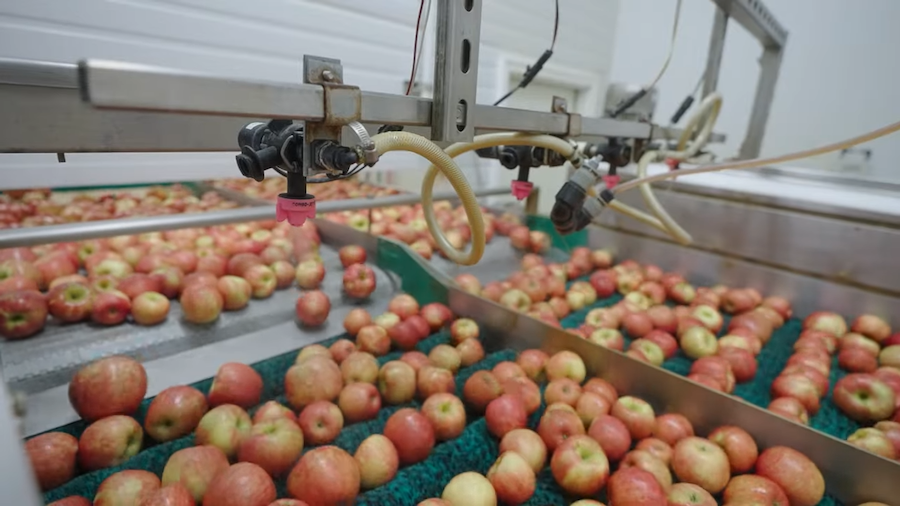
Washing and brushing at the packing line removes some of that natural coating. Many packers then apply a thin food-grade wax to replace what came off, because an apple without its cuticle dries out and shrivels within days. The coatings used are typically carnauba from palm leaves, shellac, or beeswax. All are food safe and approved for use on produce.
It is not there to make the apple shiny for the sake of it. It is there so the apple you buy in February eats like an apple. Rinse under cool water before eating, same as any produce.
Glossary
Terms worth knowing.
The words that show up on labels, in spec sheets and in conversations with growers.
Club variety
An apple that is trademarked and licensed, so only approved growers can plant it and only approved packers can sell it. Keeps supply controlled and quality consistent. SnapDragon and Ambrosia are examples.
Managed variety
Another term for club variety. The variety is managed by a licensing body rather than being open for anyone to grow.
Open variety
An apple anyone can plant. Usually because the patent expired, as with Honeycrisp in 2008, or because it was never patented, as with McIntosh.
Controlled atmosphere (CA)
Storage where oxygen is lowered and carbon dioxide raised, slowing the fruit’s respiration to near dormancy. It is how a September apple eats crisp in April. Not a treatment, just adjusted air.
PLU code
The four or five digit number on the sticker. Four digits means conventionally grown, five digits starting with 9 means organic. The code identifies the variety and often the size.
Sport
A natural mutation on a single branch that produces different fruit, usually redder or earlier. If it is worth keeping, growers propagate it. Most modern Gala strains are sports of the original.
Rootstock
The root system a variety is grafted onto. It controls tree size, disease resistance and how soon the tree bears fruit. The variety on top determines the apple, the rootstock underneath determines the orchard.
High density
An orchard system with many small trees per acre trained to a wall or trellis rather than fewer large trees. More sunlight reaches the fruit, quality goes up, and picking gets easier.
Russeting
Rough brown patching on the skin, usually from cool wet weather at bloom. Cosmetic only. It does not affect flavor and some varieties, like Ginger Gold, show it routinely.
Bitter pit
Small sunken dark spots caused by a calcium imbalance in the fruit, not by disease or pests. Honeycrisp is particularly prone to it, which is one reason it is a demanding apple to grow.
Prune plum
A plum variety with high enough sugar and low enough moisture to be dried whole without fermenting around the pit. All prunes are plums. Not all plums can be prunes.
Brix
A measure of dissolved sugar, used in cider and juice production. Higher brix means a sweeter press. Growing conditions move it season to season.
Keep Going
Put it to use.
Compare the varieties
All 19 apples scored tart to sweet on a single scale, with the reasoning behind each number.
Browse every variety
Filter by best use and season. Full profiles, harvest windows and specs on all 19.
Look up a PLU
Every code we pack, searchable by variety and size. Find out what is actually in your cart.
Still wondering something?
Is Pink Lady the same as Cripps Pink?
Yes. Cripps Pink is the variety, bred in Western Australia in the 1970s. Pink Lady is a trademark that fruit can only carry if it meets set colour and sugar standards. Cripps Pink that misses the grade is sold under its own name.
Where did Honeycrisp come from?
The University of Minnesota, released in 1991. Its crunch comes from unusually large cells that rupture rather than tear when bitten. The patent expired in 2008, which is why it is now grown across the country.
Is Fuji from Japan?
Yes. Developed in Fujisaki, Japan starting in the 1930s from a Red Delicious and Ralls Janet cross. Named for the town rather than the mountain, and brought to the United States in the 1980s.
Is the wax on apples safe to eat?
Yes. Apples produce their own natural wax coating. Washing at the packing line removes some of it, so a thin food-grade coating is applied to replace it, typically carnauba, shellac or beeswax. All are approved for use on produce. Rinse under cool water before eating.
What is a club apple?
A trademarked variety that only licensed growers can plant and only approved packers can sell. It keeps supply controlled and quality consistent. SnapDragon and Ambrosia are examples.
What is the difference between a prune and a plum?
A prune plum is a plum with enough sugar and low enough moisture to dry whole without fermenting around the pit. All prunes are plums. Not all plums can become prunes.
If it is not here, ask. We have people who have spent forty years in orchards and enjoy this stuff.